| |
 |
|
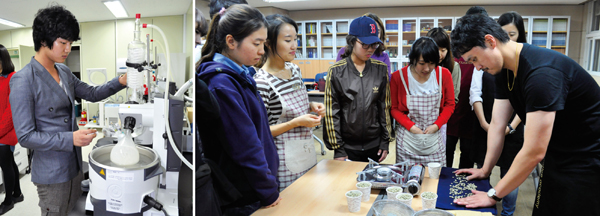
| ▲ Left, a student conducts an experiment in food biology engineering. Right, students watch carefully as an instructor discusses the roasting of coffee beans. Photos by Angela Kim |
The Jeju Water Industry Center (JWIC) has invested much effort in helping to foster students to be useful talents in the field, from theoretical knowledge education to practical training, such as offering help in writing resumes and setting up mock interviews.
Students enrolled at the center, within 13 different majors, can take free personality and aptitude tests to explore their future career options.
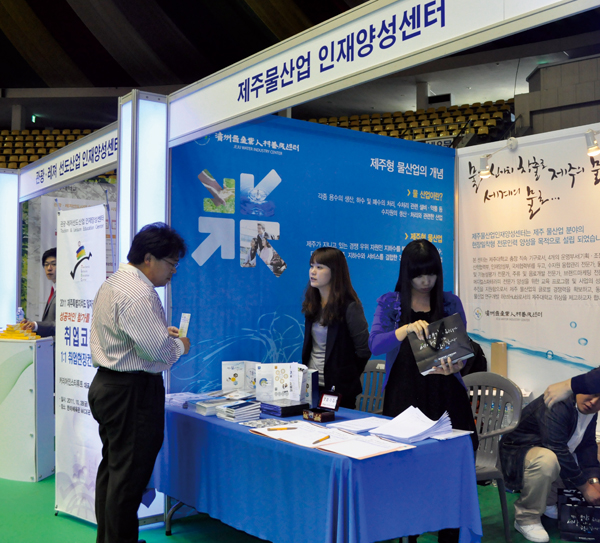
As part of its effort to increase employment opportunities for its students, JWIC co-sponsored the recent Jeju Special Self-Governing Province Job Fair, held on Oct. 28, 2011 at Halla Gymnasium. The center successfully recruited about 20 water industry employers to attend the event.
However, JWIC goes beyond just creating employment opportunities for students. It has started to provide help for students to establish their own businesses. Courses on opening an online business as well as barista instructions are provided at no cost.
From Oct. 25 to Dec. 1, JWIC is offering barista classes for 40 students who are considering opening a coffee shop in the future. The purpose of the class is to give students the opportunity to learn practical skills that will help when establishing their own business.
According to JWIC, they specifically chose to offer barista classs not only due to students’ demand, but also because of its relation to the water industry. As the center focuses on all three major sectors of the water industry — from drinking water, and beverages to cosmetics and medical therapy — the coffee industry fits nicely into its objective.
Students spend two hours a week attending unique coffee classes. Provided by the Jeju Coffee Academy, the first class started off with coffee theory and will be followed by roasting, hand-drip methods, and more.
Kang Woon Seok, a senior majoring in food biology engineering, said, “Since it’s such a rare profession, barista classes are hard to find. I’m learning a lot in a short period of time.” When asked if he planned to open a coffee shop in the near future, he answered, “Given the right opportunity and the right time, I might.”
Whether the students will open a coffee shop in the near future is hard to tell, yet JWIC hopes about 5 percent of students who took the class will seriously consider opening a coffee shop.
Also, as part of their business academy, the center is offering online business classes to 23 students. Throughout the course, students will learn the basics needed to open an online shop, ranging from Web site design to appropriate advertisement methods.
| |
 |
|
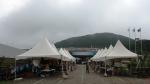
| ▲ The Jeju Water Industry Center Booth at the 2011 Jeju Job Fair at Halla Gymnasium, Jeju City. Photo by Angela Kim |
But what about those students who are interested in opening a business other than a café or online?
Nine students who are majoring in chemistry have organized a club called Honghak looking to launch a business with self-developed soju under the JWIC. Each team member spends an average of three hours a day working towards a new product. Kim Min Seok, a sophomore majoring in chemistry, decided to join the club with his friends after taking a beer brewing class last summer.
“Jeju Beer is already being developed. That’s why we decided to focus on soju,” Kim said.
For two months, they successfully made makgeolli (rice wine) which can be distilled later to make soju. The club members will present several products at its Entropy Seminar, which is a festive academic seminar for the department of chemistry at Jeju National University, for attendees to evaluate on Nov. 18, and then decide on its final product.
JWIC provides full support for the student group. Students can use its high-tech laboratory and equipment located in the JWIC building. Also, the center purchases materials required for the experiment, such as rice, chemicals and more, to encourage active student involvement.
“The best part is that we can ask questions to researchers working for JWIC when we are having problems with our experiment process,” Kim said. He is confident that by next year, they will have a viable product on the market. “I can understand my major course in a more in-depth level, [which] also helps to plan our future [to launch the Jeju soju brand,]” he added.
Team Honghak has received 2 million won (US$1,795) so far from JWIC to purchase materials needed to conduct the experiment. According to the center, any students wishing to do research for the purpose of building a business may receive a stipend to cover the costs of the experiment. Through a review process, additional funds may be given to students after they have officially registered their business.
|
|
|
|
|
|
|
|
ⓒ Jeju Weekly 2009 (http://www.jejuweekly.com)
All materials on this site are protected under the Korean Copyright Law and may not be reproduced, distributed, transmitted, displayed, published without the prior consent of Jeju Weekly. |
|
|

















)
)